Tuesday, April 26, 2011

Atkin’s Yawl…The Restoration Continues

By Capt. Jim Cash
Yikes! …The more that is done, the more surfaces that will need to be done.  Meaning, one can’t just do the surfaces that we see on top; what happens when the drawers are pulled out, the floorboards lifted, the settee backs removed?  I wanted the finished product to look, well, finished.  We couldn’t have beautifully varnished and polished cabin sole and have the bilge look like a 50 year old bilge; could we? As a result, the decision was made to disassemble as much of the interior as possible, then clean and spray paint everything white before starting on the bright work.
Also, being Southern California, the “Winter” is interspersed with beautiful sunny 80 degree days between the rainy ones.  To offset the boredom and dust filled confinements of the interior, the exterior was tackled in tandem when the sun came out.   One of the first of the challenges were the teak decks.  It was anyone’s guess when they had last had attention, but since they were solid teak planks and not a veneer laid on top of fiberglass, there was plenty of wood to work with.  When they were bleached and the natural warm golden glow jumped out, they looked like new from Mr. Johnson’s shop.  But, there were a lot of brass screw tops showing so many new “bungs,” the teak cap set in the deck to cover the brass screws, were the order of the day.
For those of you not experienced with this process, fist the old screw must be removed without breaking it—remember, they have been there for over 50 years.  Next, the hole is prepared by drilling a counter sink without enlarging the hole itself, then replacing the screw so the head is at least an 1/8th inch below the surface, then a new teak bung is glued back in the hole.  When set, the top of the bung is then chiseled off flush and sanded to meet the surfaces of the deck. We lost count after several hundred how many of these needed replaced.
All the old varnish, paint and grime had to come off every exterior surface, including cabin trunk, top, spars, cockpit, bow sprit, rails and boomkin.  The heat gun and scraper were the tools of choice.  Heat, scrape, heat scrape, was the process; inch after agonizing inch. 
Back to the interior; three coats of white interior primer with light sanding between coats was applied to every surface, both what could be seen as well as inside and behind the drawers, lockers and storage spaces under the bunks and sinks, except the cabin sole.  Boy, was it white in there!  The interior lit up like an operating room, but that was the objective.  Then, the surfaces that were to remain “bright” were scraped, sanded and varnished, then re-sanded and varnished and re-sanded and varnished and re-sanded and varnished.  We found a whole variety of hard woods had been used.  There was oak on the floors, mahogany counter edges, teak skylight and hatches; the subtle contrast of natural wood colors gave the interior a very rich and warm feel.  The surfaces that were going to stay white was painted with a satin white finish.  I’m told this white and “bright” natural wood trim is a Herrshoff style, named after the famed yacht designer Nathanial Herrshoff.
The countertops had been surfaced at one time with a white Formica type product. It was naturally stained in places and I have been trying to decide what to replace it with.  I want to stay as close to the period as possible and thought about various stone finishes, but decided that Mr. Johnson would not want the weight of a granite counter top in his boat.  I’m leaning toward a copper counter with hammered sink, brass galley pump, and teak trimmed on the sides.  Let me know what you think?
The work continues…


Tuesday, April 5, 2011

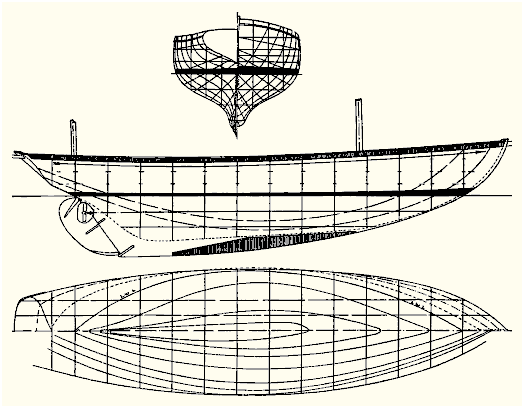
Willian Atkin's Meridian

Meridian
A 39' 4" Yawl
By William Atkin


A Seagoing Yawl
Meridian, as my old friend Capt. Abel Brown would say, is "one of them there rule cheaters," meaning that under certain racing rules she would have an advantage in handicap over a single masted yacht. However, this is not the reason she was decked out in the yawl rig. The yawl has always been well considered by cruising men the world over, and has certain advantages, not least of which is that the largest sail is pretty much over the center of the boat and nicely inboard. It is a handy rig, too, because the main and jib can be stowed and the boat be left to jog along under staysail and jigger.

Meridian is 39 feet, 4 inches in over all length; 31 feet on the water line; 10 feet in breadth, and draws 5 feet. The freeboard at the bow is 4 feet, 4 inches and at the stern 3 feet, 6 inches. The displacement is 22,600 pounds. Ballast on the keel, 8,000 pounds, with additional weight in the bilge to the amount of 2,000 pounds. So you see she is a boat of fairly large dimensions and comfortable room below decks without heavy displacement, and by the same token without excessive wetted surface. The lines show somewhat less draft than is usually associated with yachts of this type; there is, however, ample for this particular underwater form as proved by a score of predecessors. The hull is properly balanced and will sail without an excessive degree of heel.
The rig is straightforward and practical. If made exactly as shown in the sail plan without additions and omissions and without changes it will stand through anything that can blow. There is nothing experimental about any feature of the sail plan, nor nothing blindly copied from the work of other designers. It is all designed to conform to practice that has been found to be entirely satisfactory in hard service afloat.


The deck shows a shallow cockpit 6 feet, 2 inches long by 5 feet, 8 inches wide. There is a seat each side and under these the gasoline tanks. The cockpit floor is water tight the full width of the hull and the side walls under the coaming are water tight as well. The main cabin house is 4 feet 8 1/2 inches wide, with parallel sides ending forward in a hinged lid, the latter extending the full width of the deck house. Then there is a main deck and a small deck house over the forecastle. The advantage of this arrangement is its strength; that little piece of main deck spanning the beam at the mast ties the hull together properly and securely. I have drawn many designs showing the mast piercing the deck house; but this is a bad arrangement, weak, not shipshape, unhandy, and ugly looking. There is really more available room below decks with the two house deck arrangement.

The cabin arrangement is designed to accommodate four people, more than four crowd up the place; and besides it is not possible to supply locker space for clothes, food, etc., for any more than four. This is one of the faults of many cruising boats; no place to put anything. The galley is aft under the companionway and equipped with range, sink, dish lockers, lockers for cooking utensils, ice box and storage locker for food. The top of the ice box serves as a chart table. The main cabin contains a sofa on the port side with a folding box berth behind, an extension berth is on the starboard backed by large lockers. Notice the el end of the extension berth and the fixed cabin drop leaf table. There is something homelike in a cabin like this with its table always set up and berths out of sight. The toilet room is big and equipped with a regulation water closet and folding wash basin. Lockers are supplied for linen and supplies. A large hanging locker is abreast the toilet room; a real closet in which to hang clothing. There is full 6 feet headroom throughout the cabin, galley and toilet room. The stateroom contains two built in berths, lockers, bureau, and generous hanging space. Leaving an opening in the berth front makes the space below available for the storage of sails. There is also a handy locker in the forward end of the stateroom. One water tank is installed in the bow, two additional water tanks are located under the sofas in the main cabin.

The motor should be of approximately 140 cubic inches pulling about 25 h.p. at 1300 to 1400 r.p.m. The motor in Meridian sits level, a feature which has many unseen advantages. It is not necessary to use a reduction gear in this installation.

Monday, April 4, 2011

Restoring an Atkin’s Yawl …continued


Now that the purchase decision was made, Oh my God, what have I done? 

The boat had been pulled out of the water, the bottom painted and the zincs replaced by the boat yard that sold me the boat before the sea trial.  Normally, that would have been my first chore, so in the interest of saving money and not duplicating effort, I decided we should start inside and work our way out.  It was January 2011 in Southern California, rainy season, so working inside to start the project was ideal. 
           
I started by removing the sails and covers both from the spars and the fo’c’s’le and taking them to the loft. There were two set of sails, the old ones and the very old ones.  The sail maker actually recognized the names of the lofts that made them originally, (Schoonmaker Campbell Sails) though no longer in business, were considered high quality for the time.  We decided to have the newest set cleaned and repaired where necessary.  There was a large, faded red, Genoa, a staysail, a main and mizzen sails; these were left to be reclaimed later. Next was to remove everything not screwed down form the inside.  Out came anchor, chain, rode, sail covers, life jackets, cushions…even the toilet was unbolted from the floor (which was brand new, never used with the manual, still in the plastic taped to the seat) and  taken out in preparation for a complete redo of the interior. 
           
Let me digress here for a minute and discuss my philosophy of restoration of an old boat.  Ideally the total amount invested will not exceed the expected market value of the completed boat on the open market.  This number, of-course, is rather abstract.  I did research on similar vintage and type boats to learn what the asking prices were currently.  But, given the height of the depressed economy, with boat dealers and brokers dropping out like flies, and the actual sale prices of used boats at an all time low, it was anyone’s guess what my restoration budget should be…not enough, for sure.  However, I told myself, this project was for the love of the saving a piece of history, not for profit in the resale of the finished product, no matter how that went against my grain.  So, my philosophic modification was; I would not skimp or compromise on anything that was needed, but at the same time I would not be extravagant either.  Also, before making the final decision to buy the boat I did a preliminary budget, and got quotes from several of the artisans that I’ve used before, on the various aspect of the restoration, and decided that the project was worth the effort.

This brings me back to the interior finish.  When I first descended into the interior I found an all natural wood finish.  The natural oak floor boards, the walls and cabinetry all natural wood finish.  Though beautiful it also made the interior very dark.  I also learned that the interior had been modified from the designer’s original scheme.  What I couldn’t tell was weather that was a modification in the original building or a change made later.  In any event, I made the decision change the interior from all natural dark wood to the classic Hershoff style of white with natural wood varnished trimmed highlights. This decision was partially steered by economics; it’s much cheaper to paint than scrape and varnish, and partially to brighten the interior.  Having made this decision the first steps were to prepare the interior for painting.  And, so it began.     

Wednesday, March 9, 2011

Saving an Atkin Yawl
…continued
By Capt. Jim Cash
After seeing the old yawl for the first time and having ducked under the torn canvas and into the interior, I knew I was in trouble.  I was told it was a William Atkin design so I did a little research.  I googled his name and to my surprise, a link to many of his old plans came up. I found the plans for this very yawl I had crawled though.  It was called the Meridian, 39’4” on deck, 31’ on the water line, 10’ beam and 5’ draft.  It was rigged with a jib tacked to a bowsprit, a club footed staysail, main and mizzen.  She displaced 22,000 pounds and had an 8,000 pound of lead in her keel.  He (William Atkin) said it was called a “rule cheater,” meaning she had certain advantages in handicap over her competition.  However, this of course was in the early 1930s when the plans were first drawn.  All this further piqued my interest, and the desire to save this boat from the chainsaw grew even stronger.
The yawl was now the property of a local boatyard, having been abandoned by its previous owner with quite a yard tab left unpaid.  The acquaintance that had brought the boat to my attention was a salvage dealer and had done past business with the yard.  I asked, what did he think it would take to buy the boat?  He started quoting the current price of lead on the wholesale market, the value of the brass cleats and windows, the tab owed by the past owner.  I listened, less than patient, wanting to say “Yeah, yeah, yeah…so?”  I finally said “Offer them $3,500.”  Well, that didn’t cut it, but after several weeks of negotiations and the yard agreeing to haul the boat for new bottom paint and shaft zincs, and having their mechanic put in a new battery and get the old flathead four-banger “…running just like a song” to quote Johnny Cash, we came to a price.  The final price was a little more than double my original offer.
The day arrived for the sea trial and I was accompanied by a couple friends, both of whom had owned and restored wooden boats.  The owner of the yard also wanted to go, though he confessed he’d never sailed before.  I could tell that he was a little apprehensive the when the big 150% genoa was raised up the forestay.  We healed over 15 degrees and accelerated to six knots in a heart beat, and he took a step back and lowered himself down the companion way.  “Are we OK?”  he asked, his voice gravely trying to remain calm and be brave. The rest of us were smiling.
“You are going to love sailing this boat.” My friend said already knowing from my expression that my decision was made. What a ride it was that day.  Though the winds were not strong it was evident this was a real sailors boat. I agreed to buy the boat that day and as I wrote the check, I thought to myself “What am I going to do now?”
It was agreed that I could leave the boat in the water at the yard’s marina for restoration process, but I would hire my own craftsmen.  I called the paint and varnish man that had worked for me on three previous boat projects and asked for a quote.  My goal was not to invest any more into the purchase and restoration than I thought the market would bear for the finished product.  We came to an agreement with quotes for the job, broken down by a price for restoration of decks, paint topside, varnish spars, varnish topside, interior paint and varnish, and hull above the waterline.  Since the bottom had just been repainted by the yard, I decided to leave taking the bottom down to bare wood until the next required bottom painting.
The next week we stripped the sails off, bagged them up, and I took them along with the covers to the loft for evaluation.  There were actually two sets of sails, the newest of which was estimated at about 30 years old.  The interior cushions were stored in the yard’s warehouse for attention later, and the old cover was turned over to the yard’s canvas man to be re-stitched.  I paid a deposit for materials and the process began … it was mid-December 2010.

Sunday, February 20, 2011

Saving an Atkin's Yawl

Saving an Atkin’s Yawl
By Captain Jim Cash

William Atkin, and later his son John, were designers of boats in the days before production fiberglass boats were being popped out of the mold and sent down the assembly line to be glued and screwed by clock-watching hourly workers.  Atkin would sell his plans and the prospective new boat owner would, if handy, build or hire a local shipwright to build their boat.  This is what happened in 1938 when Joel Johnson, a shipwright of Fairfield, Connecticut, was retained to build a vessel from the William Atkin plans called “Meridian,” a yawl rigged sailboat, 39’4” on deck, with a club footed staysail and the cutest little dog house on the foredeck.
Fast forward almost 80 years.  It was October, and I was attending the 34th annual Wooden Boat Festival in Port Townsend, Washington.  I guess I caught the “bug.”  It was subtle, so my immune system did not know to fight it with a vengeance.  I found myself inquiring about the prices of various wooden boats, with no real intention of course, of actually buying one.  My God, who in their right mind would want to take on the headache involved with the maintenance and upkeep of an old wooden boat? 
Then one day, several months later, I got a call from an acquaintance who had heard my murmurings about how those old boats were really works of art, not just wooden modes of transportation … a weak moment I’m sure.
“I saw a boat you will want to see” says he.  “It’s an old schooner or something. The boatyard is going to cut it up for the lead keel if someone doesn’t buy it …Are you there?” he inquired further, my silence deadening.  I’ll only go to look; I said to myself, what harm could it do?  If the yard is going to cut it up, it surely is beyond repair; what a shame!

As I approached, I saw the tattered full canvas cover almost totally obscuring the topsides.  The distinctive short mizzen mast, placed far aft, and the tall main mast forward, gave away the fact that she was a yawl, very rarely seen in modern marinas any longer.  The long low sheer line, the bowsprit and the bomkin at the stern, all added to my intrigue.  My thoughts were “What a beauty!  What lines!  What a work of sailing art!”  I was clearly having a full-blown attack of “Woodenboat-itis.” 
I lifted the corner of the cover and scooted under the canvas.  It was all there, the rack and pinion reverse steering with the wood spoke wheel, the brass winches, the wood horn cleats; there were even brass belaying pins nestled in holders at the base of the Douglas Fir mainmast with three-strand line figure-eighted in place.
I removed the teak hatch boards to the companion way with a slight shake to my hands and beads of cold perspiration appearing on my forehead.  I cautiously descended, waiting for the telltale smell of wood rot, which was not there.  Right there on the teak trim over the hatch was a brass plate inscribed with the builder’s name, Joel J. Johnson, Fairfield, Connecticut.  I stepped down into the aft cabin, she was tight, not even a musty odor, only a sight layer of water kissing the bottom of the bilge.  Oh, the joinery, the woodwork, the craftsmanship.  The interior was like looking at antique furniture, not a mere boat.  A pocket door separated the aft cabin, with opposing pilot berths, from the main salon.  A long settee on the starboard side actually slid outward to covert into a double bed.  The galley hugged the port side and the louvered cabinet doors swung open and shut with ease.  Stepping forward out of the main salon past a head with toilet, a real porcelain sink, mirror and storage, I had to duck under the deck where the mast came through to stand upright again in the small dog house built above the fo'c's'le where another double berth shared the bow with the exposed anchor locker.
I was smitten.  I could not let it happen.  I could not let them cut her up.  She had to be saved.
(To be continued…)